Pattern-Matching is Not Intelligence
Why LLMs are Trapped in the Noise

Original post by Suresh L. Paul — Economist and AI Expert. Re-printed here with author’s permission.
The fundamental flaw in our current AI discourse is a category error: we have confused sophisticated pattern-matching with superior intelligence.
As Large Language Models (LLMs) scale, we mistake their increasingly smooth outputs for genuine cognitive depth. In reality, pure pattern-matching lacks the two foundational pillars of true intellectual evolution: Neuroplasticity and Bayesian inference. Without them, scaling up parameters doesn’t breed genius—it simply builds a more efficient machine for staring into the void.
The Illusions of the Century
The basic tenet of pattern-matching is simple: the Universe is full of dots. Connect the right ones, and you can draw almost anything.
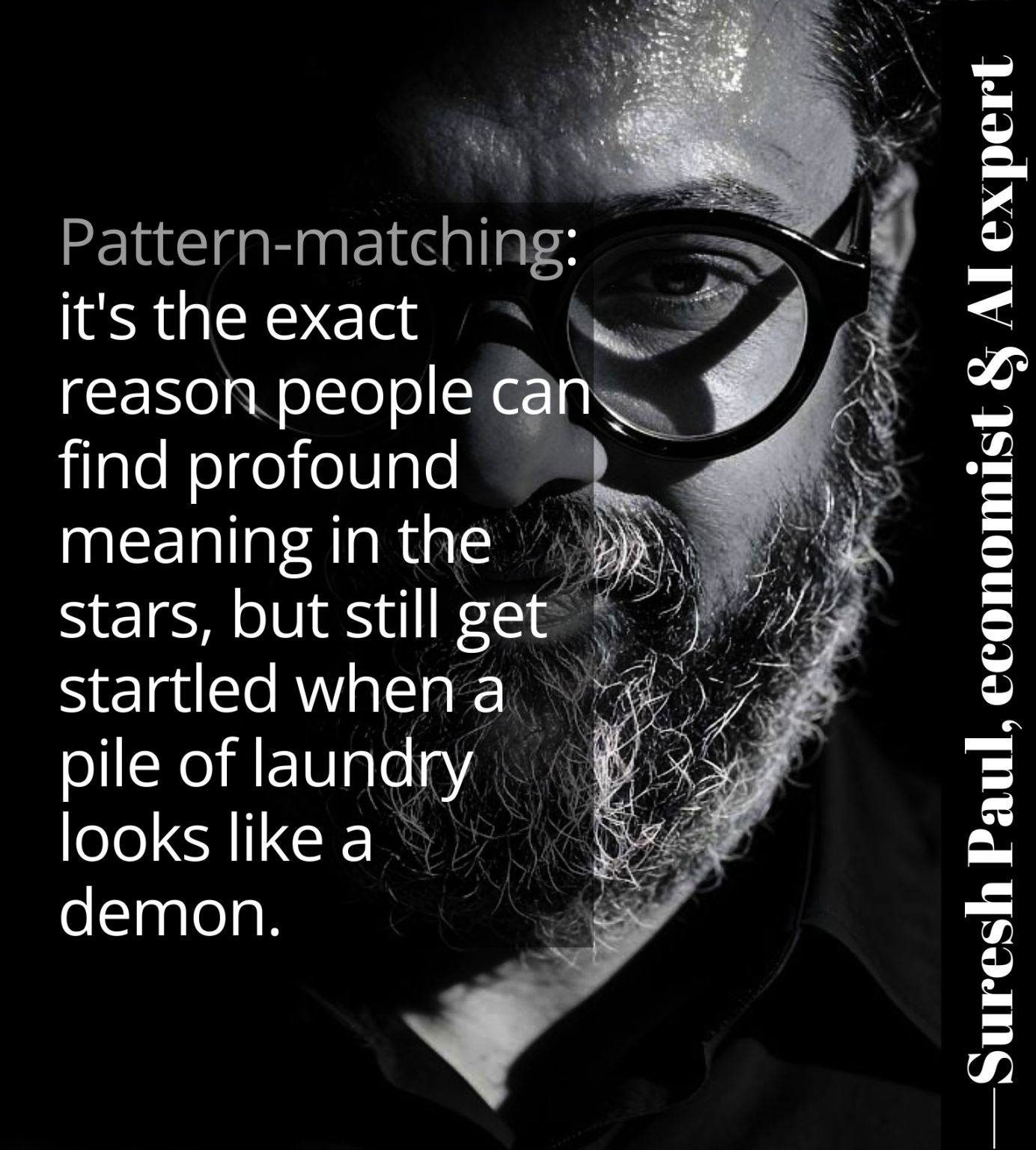
[Random Data/Noise] ---> [Pattern-Matching Filter] ---> [Imposed Order (Stars/Demons)]It is the exact reason scholars can find profound meaning in the stars, while an individual can still get startled when a pile of laundry looks like a demon in the dark. Both are staring at random noise and drawing what they want to see.
In humans, what we “want to see” is dictated by whatever brand of intelligence our century currently finds fashionable or acceptable—the system’s context. An LLM does not understand reality; it optimizes for the statistical probability of the context it has been fed. It is a mirror of our historical data, not an engine for new truth.
Neuroplasticity vs. The “Creative” Hallucination
To understand why LLMs are hit with a cognitive ceiling, we have to look at how biological systems actually achieve breakthroughs.
The Biological Engine: Neuroplasticity is the brain’s lifelong ability to structurally reorganize itself when learning something radically new or difficult. It requires structural change, not just parameter tuning within a fixed architecture.
The AI Parallel: Structurally, neuroplasticity is identical to AI hallucination—the act of connecting dots that “don’t belong together.”
Truly creative humans possess brains that habitually hallucinate connections between disparate ideas. Statistically, there is a well-documented link between high creativity and schizotypy—the psychological tendency toward unusual perceptual connections.
If you eliminate the capacity to connect the “wrong” dots, you eliminate the capacity for paradigm shifts. The alternative to hallucination isn’t objective truth; it is just the sterile, predictable outcome of an overfitted model.
The Missing Anchor: Bayesian Inference
If hallucination is the price we pay for higher intelligence, why aren’t creative humans completely detached from reality? Because biological systems possess a grounding mechanism that AI currently lacks: Bayesian Inference.
To prevent neuroplasticity and creative leaps from devolving into profound stupidity, the human mind constantly updates its probabilistic assumptions by testing its internal hallucinations against the physical world.
If I “hallucinate” that I can fly, gravity acts as an immediate, unyielding feedback loop that corrects my internal model. The environment forces the system to adapt or perish. LLMs, operating purely within tokenized environments, lack this physical substrate. They update weights based on loss functions derived from static datasets, not from friction with reality. Without an external, objective anchor to prune the noise, the model’s pattern-matching eventually cannibalizes itself. This is why the next true leap in discovery will only happen when AI is trained on the physical world, not just textual content.
The Systemic Outlook
We must stop treating hallucinations as a bug to be patched out through brute-force RLHF (Reinforcement Learning from Human Feedback). When we over-align models to eliminate all variance, we don’t make them smarter—we turn them into hyper-efficient bureaucrats of existing data.
Superior intelligence requires the danger of being wrong. Until we design architectures capable of structural reorganization (true neuroplasticity) tethered to real-world feedback loops (Bayesian grounding), LLMs will remain what they have always been: brilliant mimics, lost in the stars.
What are your thoughts? Are we spending too much effort trying to make AI “safe” and predictable at the expense of true cognitive breakthroughs? Let’s discuss in the comments below.